
A well done remodel can add lots of value to your home and make it more enjoyable for your friends and family for the next decade or more. But a poorly done update can lead to a lot of frustration and regret. The difference often comes down to the contractor you choose.

A well done remodel can add lots of value to your home and make it more enjoyable for your friends and family for the next decade or more. But a poorly done update can lead to a lot of frustration and regret. The difference often comes down to the contractor you choose.
Ask these questions of every contractor you meet with (even us!) and you'll be on your way to finding the right contractor for your needs.
'Contractor' is a catch all term that can mean many things. A Trade Contractor is very different than a Licensed Contractor.
Quality work is key, but don't overlook quality of service. A well built project is often ruined by a process that takes much longer, costs more and creates a lot of frustration and disruption to your daily routine.
For larger remodeling projects you want to meet with Licensed Contractors who specialize in remodeling. New construction and remodeling may seem similar but they are significant differences in the type of contractor who do each.
First Read "Types of Contractors Below". Then review our checklist for evaluating contractors.
It's surprising how many people call for estimates with out doing any initial reseach online.
Good website research will save you time and make sure you are calling the right contractors.
This is where you get your first sense of the level of service a contractor provides and how organized they are.
For most contractors this is the final time you will see them before making a hiring decision.
Bonus if they meet in person to review your estimate with you (if they don't offer to review the estimate with you I would ask them to).
There is a lot of confusion about the different types of contractors that gets people in trouble on thier projects. To confuse things further the term 'licensed and insured' is used incorrectly by many trade contractors and dishonestly by others.
For simplicity sake it's easy to think of contractors being in three buckets: trade contractors, licensed trade contractors and licensed contractors.
Trade Contractors are unlicensed. No licensing is requited by the city, country or state of Florida.
Think tile contractors, drywall contractors and carpenters. A trade contractor can perform multiple trades as well, as long as none of those trades require a license.
Handyman services are a type of trade contractor. Unfortunately a lot of these services pass themselves off as licensed contractors and perform work they should not. That's what get's people into trouble.
Licensed trade contractors are required to be licensed by the State of Florida. To get a license you have to:
1. Pass a lengthy exam that covers building code, business practices, and technical skills
2. Prove work experience including referrals from other licensed contractors,
3. Carry minimum amounts of insurance and pass minimum financial requirements
4. Acumulate continuing education credits to renew your license every 2 years
Electrical, Plumbing, HVAC and Roofing are Licensed Trade Contractors. They perform a single trade but are required to be licensed.
This is what most people refer to as a 'General Contractor or GC' but in reality there are a few types of Licensed Contractor. Licensed contractors undergo the same strict process as Licensed Trade Contractors.
1. General Contractors (license # starts with CGC followed by 7 numbers) can build anything, commercial or residential of any size of height.
2. Building Contractors (license # starts with CBC followed by 7 numbers) can build anything residential but are limited to what is called "light commercial' work.
3. Residential Contractors (license # starts with CRC followed by 7 numbers) can only build residential structures under 3 stories. Our residential license number is CRC1331326 for example.
You can look up any contrator online to see if they have a valid license: Florida Contractor License Lookup
If a Trade contractor tells you they are 'licensed and insured' but don't have a State Certified Contractors License as outlined above then they are confused or lying.
A lot of trades use the term 'licensed and insured' without understanding what it means, they just know that's what people want to hear.
There are no licenses for most trades. If you want to be sure then visit the website listed above to check.
There are 4 types of insurance you want your contractor to carry:
1. General Liability Insurance protects against damage to your home and injury. Licensed Contractors are requited by law to carry a min $300,000 policy though better contractors will carry a $1,000,000 policy.
2. Workers Compensation Insurance covers workers who are injured on the job. Any business with employees are required to carry is by law. Owners and partners can file for exemption.
3. Commercial Auto covers damage or injury from auto accidents (contractor backs ino your mailbox for example)
4. Builders Risk Insurance protects against material theft or damage from things like storms during contruction. Builder's Risk is most often used during new construction but can be used in remodeling as well. Each policy is bought specific to the project.
Proof of insurance should be on the contractors website, we email a copy to every new client before our first meeting.
But the best way to collect proof of insurance is to ask you contractor to have thier insurance company email proof of insurance to you. That is the best way to know the policy is still in effect.

Any good contractor should have at least a basic website. It should be easy to find their contact information, license number and an explanation of how they work.
In addition they should have case studies of past projects, a list of services and frequently asked questions.
On The Home page:
License number, description of services, testimonials, how to get an estimate.
On the About Page
How many staff and what are their roles? Do they have designers and project managers in house? Do they have support staff?
Does it show proof of insurance and their license?
Services Page
Do they specialze in the type of work you want done or do they do a whole bunch of different things?
Project Gallery/Case Studies
How does the work look? Does the type of work in their project gallery match what their services page says?
Cost page
Do they have a cost page to with some basic cost ranges for different project types?

The initial call can tell you a lot about a contractor, how organized they are and how they work.
Observations to Make on the Initial Call
1. Is the phone answered quickly and professionally?
Are they preparred and seem to have an organized process for collecting the information they need?
Do they take the time to explain how they work and answer your questions thoughfully?
If you leave a message do they call back promptly?
Questions to Ask
1. When can the intial home visit be scheduled and when can you expect to receive the estimate?
2. What is included in the estimate?
- Conceptual plans?
- Design costs?
- Project management costs?
- Line item labor and material costs?
3. How detailed is the estimate?
4. How close are your estimates to actual final project costs?
5. What do you thing a realistic budget would be for this project?
6. Do you review the estimate with me? If not, what happens if I have questions or want changes made?
7. If I approve the estimate, what happens next?
8. Do you have a designer on staff or one you recommend?
9. Who orders materials and how are they stored?
Nothing is more valuable than an in person meeting. Ideally you would have two meeting with your contractor... A home visit to discuss the project, your needs and for them to get detailed measurements. And a second visit to review your estimate together.
The second meeting can be back at your home but I think its a good idea to visit their contractors office or showroom so you can meet other staff and get a better sense of their business.
To Prepare for Visit:
1. Print a list of things you want done
Having a list ready for each contractor helps avoid confusion. It also acts a guide so you can ask speficic questions about how things are installed.
2. Do a little organizing.
Having the room(s) and counters clutter free will just help to get more accurate measurements.
Questions to Ask:
1. Do they use sub contractors or in house labor?
Licensed trades like electric, plumbing and HVAC must always be subcontracted. In house labor usually means using 'jack of all trades' type guys to do the work. Usign sub-contractors means a specialist is doing each part of the project.
2. Are the in house staff employees (w-2) or independent 1099 contractors?
This could be a red flag....Some contractors 1099 their employees to avoid workers comp and income tax costs. This shifts more risk to the homeowner.
3. How do they protect the home, control dust and dispose of debris?
Will there be a large rolloff dumpster on site? Are HEPA filters used during demo?
4. Who provides materials?
Do you need to buy and store them or does the contractor take care of that?
5. How are materials stored on site?
Do they have a trailer or do you need to provide garage space?
6. When can I expect my estimate?
Do they meet with your to review it in person or do they just email it to you?
While not many contractors have thier own showroom like we do it is a best practice to review the estimate together whether that is back at your home or in their office or showroom.
Good estimates are quite lengthy and costs can vary widely depending on the Scope of work and materials included.
Reviewing the estimate in person with your contractor allows you to ask questions, understand the estimate completely and explore options.
A common question is 'where do we start'? It can be confusing as to whether you start with a designer or a contractor. Or maybe you should start by visiting showrooms and looking at materials?
You can start with a designer but they will not be able to provide you an accurate estimate of labor costs.
You can start with a contractor but many won't bid without a design or won't be able to provide an accurate estimate without one. And they rarely can provide accurate material costs.
That's why working with a design build remodeling contractor like McManus Kitchen and Bath makes sense. All of our estimates include design concepts and a Good Better Best estimate. Learn more here.
| Showrooms | Designers | Traditional Contractors | McManus Kitchen and Bath | |
| Product Knowledge | Yes | Some | No | Yes |
| Design Expertise | Some | Yes | No | Yes |
| Provides Estimates | No | No | Yes | Yes |
| Manages Project | No | Some | Yes | Yes |
| Construction Expertise | No | No | Yes | Yes |
| Has a Showroom | Yes | No | No | Yes |
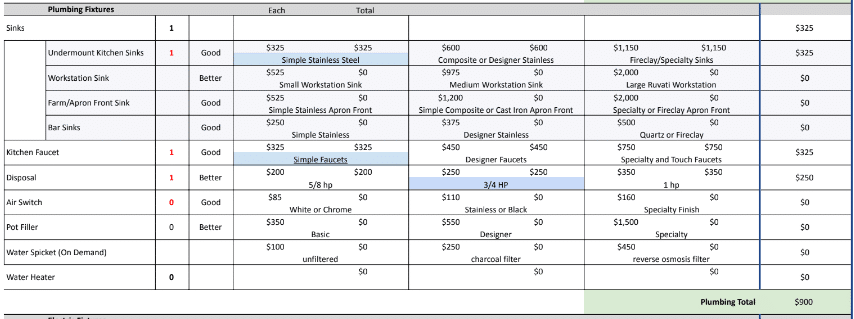
1. Summary
A paragraph or two at the very top that explains the scope of work in plan language and includes any special notes from the consult.
2. General Items Section
3. Labor Section (Scope of Work)
4. List Installation Materials Included
5. List of Selections or Allowances
6. Cost summary
7. Timeline Summary
1. How long is the estimate?
2. What is included in the total?
3. How Accurate is it?
4. What's the next step?
5. Is there a warranty?
If you found these checklists helpful or would like to see something added to them let us know! You can contact us here.

Are you willing to spend extra money, waste time, and possibly set your project back months because you didn't hire t…


What you’ll get:
A personal design consult in our showroom
3D drawings to help you visualize options
A ‘good-better-best’ estimate